Boost Your Child's Confidence in Tough Soccer Matches
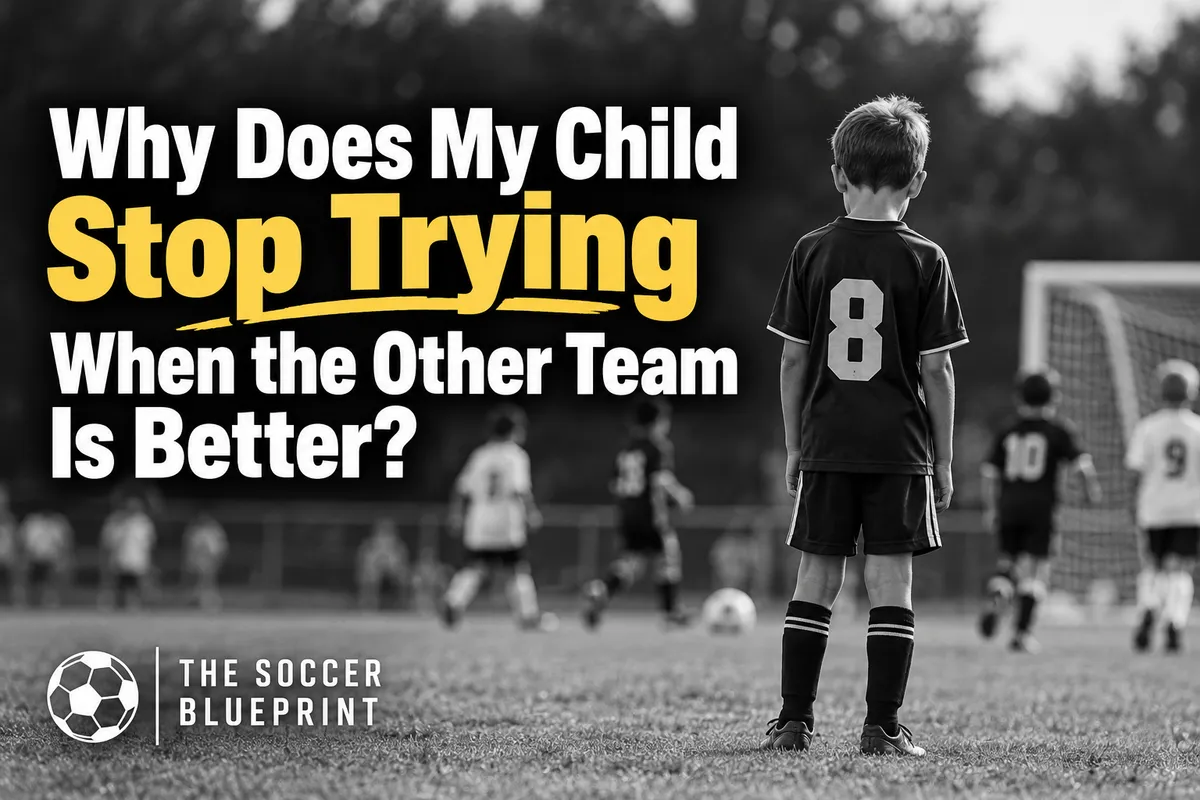
Why Does My Child Stop Trying When the Other Team Is Better?
I've watched this happen countless times in youth soccer.
Your child's team starts the game with plenty of energy. Everyone is running around, chasing the ball, and enjoying themselves.
Then the other team scores.
And scores again.
Before you know it, the score is 6–0. Then 8–0.
You look onto the field, and your child is barely running. They're watching the ball go by. They don't seem particularly interested in chasing anyone anymore.
And you're standing on the sideline thinking:
Why aren't you trying?
I don't care if you lose. Just give me some effort.
Why have you completely checked out?
I understand that frustration. I believe effort matters, too.
But after years of coaching young players, I've learned something that I think every soccer parent needs to understand.
Sometimes your child hasn't decided to give up. Sometimes the game has simply stopped being fun.
And at six, seven, or eight years old, that distinction matters.
We're Watching the Same Game Through Two Different Lenses
Let's talk about what goes through a parent's mind.
You've paid the registration fees. You've rearranged your work schedule to get your child to practice. You've left work early, spent evenings driving to training, and skipped activities you might otherwise have enjoyed.
Then Saturday arrives.
You're excited to watch your child play. You've invested time, energy, and money into making this experience possible.
And when your child appears to stop trying halfway through the game, it's frustrating.
I get it.
I believe effort should be nonnegotiable.
But here's the problem.
Your eight-year-old doesn't necessarily see the world that way yet.
We're talking about children who are still learning to remember to flush the toilet and brush their teeth without being reminded.
And somehow, we're expecting them to demonstrate sustained concentration, mental toughness, and accountability for an entire soccer game that's already completely out of reach.
Think about that for a moment.
We're watching through the lens of commitment, sacrifice, and expectations.
They're watching through the lens of an eight-year-old who came to play soccer and have fun.
We're at the same field, but we're experiencing two completely different events.
At This Age, Fun Is Still a Powerful Motivator
When I talk about children ages 6–9, I always come back to enjoyment.
That doesn't mean every moment needs to be easy. It doesn't mean children shouldn't be challenged. And it certainly doesn't mean effort isn't important.
But children experience fun differently.
Some love scoring goals. Some enjoy competing. Some love being with their friends. Others are simply happy running around and being part of a team.
There isn't one universal definition of fun for a young soccer player.
Now imagine that child's team is losing 9–0.
They're barely touching the ball. The other team is faster and stronger. Every time they get possession, someone takes it away.
The game is no longer competitive.
And for many children, it's no longer particularly enjoyable.
What happens next?
Their minds wander.
They start thinking about what they're doing after the game. They notice their parents on the sideline. They wonder when the game will end.
Maybe they're already thinking about lunch.
What looks like a child refusing to compete may simply be a young mind that has moved on from an experience that is no longer engaging.
That doesn't mean we celebrate a lack of effort.
It means we understand the age of the child we're evaluating.
Mental Strength and Confidence Are Still Developing
I believe mental strength and confidence are closely connected.
When children feel capable, they're often more willing to stay involved. When they're repeatedly unsuccessful, that confidence can begin to disappear.
Think about a young player who normally enjoys dribbling.
Against an evenly matched team, they're constantly involved. They take chances, try things, make mistakes, and keep playing.
Now put that same child against opponents who are significantly stronger.
Suddenly, nothing works.
They lose the ball every time they receive it. They can't get past anyone. They're struggling to keep up.
Eventually, they may stop asking for the ball altogether.
Is that a lack of effort?
Possibly.
But it may also be a child who has lost confidence and doesn't know how to respond.
And sometimes it's even simpler than that.
They're eight years old, and they've lost interest in a game that stopped being enjoyable twenty minutes ago.
We need to be careful about turning age-appropriate behavior into conclusions about a child's character or future potential.
What Should the Coach Do When the Game Gets Out of Hand?
Here's something I've learned from coaching young children.
You can't always predict which child is going to show up mentally on Saturday morning.
Some days they're energetic and engaged. Other days they're distracted, tired, or simply not as enthusiastic.
That's part of coaching young children.
I don't believe it's the coach's responsibility to manufacture the perfect mental state in every player.
The responsibility is to take the group you have that day and make the best of the experience.
When a game becomes a blowout, there are still things a good coach can do.
Substitute frequently. Give the children water breaks. Find small moments worth celebrating.
Maybe Jenny continues chasing an opponent even though her team is losing badly.
"Good job, Jenny! Way to keep running after that player!"
Maybe another child makes a good pass. Celebrate it.
Maybe someone makes a strong defensive effort. Recognize it.
Those moments may not change the score, but they can change how a child experiences the game.
At this age, I want coaches finding reasons to encourage children rather than constantly reminding them how badly things are going.
And when the final whistle blows?
High-fives for everybody.
I don't need a detailed postgame recap explaining why we lost 9–0.
I don't need eight-year-olds standing around listening to a lecture about accountability.
Let's send everyone home on a positive note.
There will be plenty of opportunities to teach effort, responsibility, and competitive habits as these children develop.
The Car Ride Home Is Not the Time for a Lecture
This is where I think parents can make a significant difference.
Your child's team just lost 9–0.
You spent the second half watching your child barely participate. You're frustrated. You want to talk about effort.
You want them to understand that giving up isn't acceptable.
I understand all of that.
But my recommendation for the car ride home with an eight-year-old is pretty simple.
Talk about something other than soccer.
Ask where they'd like to go for dinner. Talk about what you're doing that afternoon. Maybe you're stopping at a Pokémon show.
Move the conversation toward something positive.
Remember, the game is over.
Your child doesn't need to spend the next thirty minutes reliving an experience that probably wasn't much fun in the first place.
And if you absolutely feel the need to talk about soccer, try something like:
"Hey Johnny, what was your favorite play today?"
Then listen.
Maybe they remember a good pass. Maybe they enjoyed playing with a friend. Maybe their favorite moment was something you didn't even notice.
That's okay.
You don't need to turn their answer into a coaching opportunity. You don't need to explain what they should have done differently.
Sometimes the most productive thing you can do after a difficult game is simply allow your child to move on.
At this age, protecting their enjoyment of the sport is often more valuable than winning an argument about effort.
Does That Mean Effort Doesn't Matter?
Absolutely not.
I believe effort should be part of every player's development.
But there's a difference between introducing a standard and expecting a young child to consistently meet that standard.
At ages 6–9, we're laying the foundation.
We're encouraging children to keep participating, recognizing positive effort, and helping them experience competition without making every mistake or difficult game feel like a personal failure.
As children grow older, those expectations naturally change.
Between ages 10 and 12, many players begin developing a greater understanding of responsibility, persistence, and their role within a team.
By U13, particularly in highly competitive travel programs, accountability becomes a much more significant part of the environment.
Coaches may begin making playing-time and team-placement decisions based partly on effort, commitment, consistency, and competitive mentality.
In some highly competitive programs, these are the years when clubs begin evaluating which players are prepared for the demands of the next stage.
But even then, we need perspective.
A thirteen-year-old is still a child.
Even highly committed young players have difficult days. They lose focus, get frustrated, and don't always respond perfectly.
Accountability doesn't suddenly appear at U13.
The expectations and consequences become more significant as children mature.
And that's an important difference.
What If Your Child's Team Gets Blown Out Every Weekend?
Sometimes a young team simply isn't very good.
That's the reality of youth soccer.
They may have inexperienced players. They may be competing against stronger teams. They may struggle throughout the entire season.
And there's only so much a coach can do with the group they have.
But I don't necessarily see that as a reason for parents to panic.
Instead, I think it creates an opportunity to learn something about your child.
Pay attention to what happens as the season comes to an end.
Does your child want to play again? Do they want to stay with the same group of friends? Are they excited about another season?
Or are they beginning to lose interest?
Sometimes the most important information comes from a conversation that doesn't sound particularly important at the time.
Imagine your child says:
"Hey Dad, can I try to make Bobby's team next year? They're really good."
To me, that's a green flag.
Your child is telling you something.
They still want to play soccer. They're interested in another opportunity.
Maybe they want to challenge themselves. Maybe they want to play with a friend.
Whatever the reason, they're showing an interest in continuing.
And that's valuable.
Another child might say they want to stay on the same team because all their friends are there.
That tells us something, too.
At ages 6–9, I wouldn't automatically interpret one response as better than the other.
Children are different. Their motivations are different. And their developmental needs are different.
Sometimes the best way to understand what your child needs next is to stop telling them what they should want and start listening to what they're already telling you.
One Thing I Want Parents to Remember
The next time your child stops running during a game that's already 8–0, remember something.
You're watching through an adult's eyes.
You understand sacrifice, commitment, accountability, and effort.
Your child is still learning those things.
They may not understand why the game should remain important when it's no longer competitive or enjoyable.
And that's not necessarily a problem we need to solve on the sideline.
It's part of growing up.
Our responsibility is to introduce those values gradually, encourage positive behaviors, and keep the experience appropriate for the child's age.
We can believe in effort without expecting an eight-year-old to think like an adult.
Those two beliefs can exist together.
The Parent Anchor
Effort matters. But before judging your child's effort, make sure your expectations match their age, maturity, and experience.
A young player mentally checking out during a blowout isn't necessarily showing you who they'll become.
Sometimes they're simply showing you that they're eight years old.
And that's okay.
A Final Thought
I want children to learn how to compete.
I want them to develop confidence, persistence, accountability, and mental strength.
Those qualities matter in soccer and well beyond it.
But I also want them to enjoy being children.
There will be time for greater expectations, more accountability, and difficult conversations about commitment and competitive standards.
At six, seven, or eight years old, I'm much more interested in whether a child wants to return to the soccer field next Saturday.
Because if we lose their enjoyment of the game before they've had the chance to develop, we've missed something far more important than the final score.
Want to make more confident decisions about your child's soccer experience?
The Soccer Blueprint helps parents understand youth soccer development, evaluate coaches and clubs, and make better decisions at every stage of their child's journey.
Visit www.thesoccerblueprint.com to learn more.
