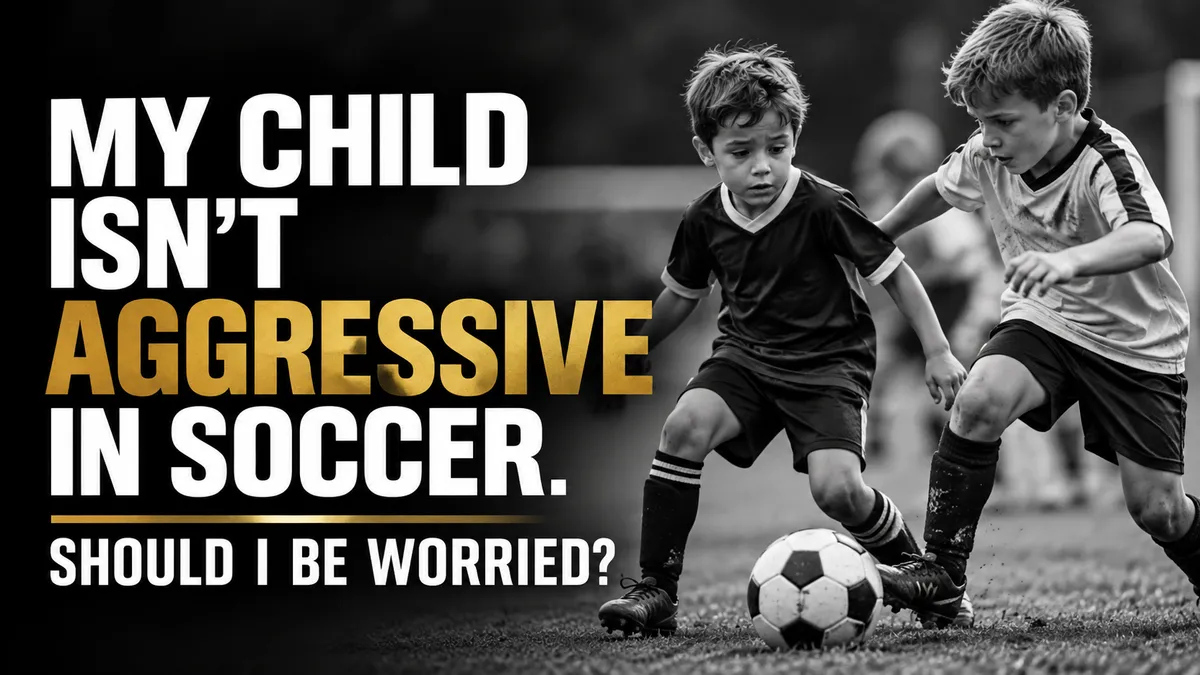
My Child Isn't Aggressive in Soccer. Should I Worry?
My Child Isn't Aggressive in Soccer. Should I Be Worried?
It's Saturday morning. You're watching your eight-year-old play soccer.
The ball rolls between two players. Your child has an opportunity to challenge for it, but instead of stepping toward the ball, they hesitate.
Another player comes charging in, wins possession, and runs away.
A few minutes later, it happens again.
You find yourself saying something you've probably said before.
"Come on! You've got to be more aggressive!"
And by the end of the game, you're wondering:
Why won't my child fight for the ball?
Are they scared?
Are they just not aggressive enough to play soccer?
I've heard versions of these questions from parents for years.
But I think we're often looking at the situation the wrong way.
Before deciding your child isn't aggressive enough, we need to understand what aggression actually means to a young soccer player.
Your Child May Be Experiencing Something Completely New
Think about what we're asking a six-, seven-, or eight-year-old to do.
We're putting them on a field with other children, telling them to chase the same ball, compete for possession, and sometimes physically challenge another player to win it.
There will be shoulders brushing against shoulders.
There will be pushing, bumping, and moments when two players arrive at the ball at the same time.
For some children, that's exciting.
They run straight into those situations without giving it much thought.
For others, it's uncomfortable.
And I think parents sometimes forget something important.
Many young children have never been in an environment where this kind of physical competition is expected.
They've been taught to share.
They've been told not to push.
They've been encouraged to keep their hands to themselves.
Now they're playing a sport where physical contact, within the rules, is part of competing.
That takes some getting used to.
Some children adapt quickly. Others need more time.
Neither response automatically tells us how good a soccer player that child can become.
Being Aggressive and Understanding How to Compete Are Not the Same Thing
Here's where I think we need to change the conversation.
A parent sees their child hesitate when another player approaches.
The parent interprets that hesitation as a lack of aggression.
But what if the child simply doesn't understand what they're supposed to do?
Where should they run?
When should they challenge?
How do they approach another player?
What should they do with their body?
How can they win the ball without fouling?
Those are things that can be taught.
And when children understand what they're being asked to do, something interesting happens.
They begin to gain confidence.
Direction creates understanding. Understanding builds confidence. And confidence makes a child more willing to compete.
That's a very different approach from simply telling a child to be more aggressive.
"Go Out There and Be More Aggressive!" Isn't Coaching
Imagine you're driving your child to a game on Saturday morning.
You turn to them and say:
"Today I want you to be more aggressive. Go battle those kids. Don't let them push you around."
What exactly have you taught them?
Have you explained how to approach an opponent?
Have you shown them how to position their body?
Have you helped them recognize when they should challenge for the ball?
Probably not.
You've given them an expectation without providing the information needed to meet it.
And for a child who is already uncomfortable with physical contact, that expectation may make things worse.
I've seen parents use words like "push," "hit," or "kick" when they're frustrated that their child isn't competing physically.
But that's not what we should be teaching.
Soccer isn't about teaching children to hurt other players.
It's about teaching them to compete within the rules of the game.
A child who understands how to challenge for possession doesn't need to become reckless or overly physical.
They need to understand what they're doing.
You can't expect confidence from a child who hasn't been taught how to handle the situation.
Can Aggressiveness Actually Be Taught?
I believe it can.
But perhaps not in the way parents imagine.
I don't think the solution is to repeatedly tell a child to become tougher.
I think the solution starts with education.
A good coach can teach a young player how to approach an opponent, when to challenge, how to protect the ball, and how to use their body appropriately.
Then the player gets opportunities to practice those situations.
At first, they may hesitate.
They may lose the ball.
They may back away from contact.
That's okay.
As they gain experience, the situations become more familiar.
The player begins recognizing what's happening instead of reacting to something they don't understand.
And once they know what they're supposed to do, they're more likely to attempt it.
That's development.
It may not happen in one practice or one weekend.
But over time, you can begin seeing changes.
Maybe your child starts stepping toward an opponent instead of backing away.
Maybe they challenge for a loose ball they would have avoided a month earlier.
Maybe they become more comfortable protecting possession when another player approaches.
Those are meaningful signs of progress.
And none of them requires your child to become the most physical player on the field.
Not Every Good Soccer Player Is a Physical Player
This is another distinction I want parents to understand.
There are different styles of soccer players.
Some players are naturally physical.
They enjoy contact, compete strongly for possession, and are comfortable using their bodies.
Other players develop into more technical players.
They rely on their first touch, positioning, passing, awareness, and ability to avoid pressure.
You can see these differences even at the professional level.
Some players thrive in physical battles.
Others are exceptional because they recognize situations early enough to avoid unnecessary contact.
Both can be effective.
Now, that doesn't mean a technical player should be afraid of every physical challenge.
All players need to learn how to compete and protect themselves within the game.
But I don't want parents assuming that the most aggressive child at age eight is automatically the best player.
Or that a quieter, less physical child has less potential.
A player's willingness to compete matters. But physical aggression is not the same thing as soccer ability.
Some Children Simply Need More Time
Between ages six and nine, children are still becoming comfortable with their bodies.
They're learning coordination.
They're learning balance.
They're learning how to move in crowded spaces.
And they're learning what happens when another player challenges them physically.
Some children adapt naturally.
Others develop that comfort gradually.
A child who avoids contact at seven may be much more comfortable with it at nine.
But there's another possibility we should acknowledge.
Some children experiment with soccer and eventually discover that they don't particularly enjoy the physical side of the sport.
And that's okay too.
Not every child will gravitate toward the same activities.
Our job as parents isn't to force every child into becoming a particular type of athlete.
It's to provide opportunities, encouragement, and good instruction while paying attention to how the child responds.
So When Should a Parent Actually Be Concerned?
I wouldn't become concerned simply because my seven-year-old isn't the most aggressive player on the field.
I'd want to understand a few things first.
Does my child enjoy soccer?
If they're excited to go to practice and enjoy playing, that's important.
Are they becoming more comfortable over time?
Maybe they're still hesitant, but they're beginning to challenge for balls they previously avoided.
That's progress.
Are they receiving instruction that helps them understand how to compete?
A child can't improve at something they've never been properly taught.
Are they afraid of contact, or do they simply prefer a less physical style of play?
Those are two different things.
Is the physical environment appropriate for their age and ability?
If a child is constantly overwhelmed by bigger, stronger, or more experienced players, we should examine the environment rather than immediately question the child's personality.
And finally:
Does my child actually want to continue playing soccer?
That's a conversation worth having, particularly if the discomfort persists.
If a child is consistently distressed by contact or afraid of being hurt, I wouldn't simply tell them to toughen up. I'd work with the coach to understand the situation and make sure the environment is safe and appropriate.
What I Would Tell Parents to Do Next
The next time you watch your child hesitate to challenge for the ball, resist the urge to shout, "Be more aggressive!"
Instead, observe.
Are they unsure where to go?
Do they back away when another player approaches?
Do they seem surprised by physical contact?
Do they understand when and how to challenge?
Then have a conversation with their coach.
Not necessarily about making your child more aggressive.
Ask something more useful:
"Can we help my child become more comfortable challenging for the ball?"
That's a coaching question.
It gives the coach something specific to teach and gives your child something specific to learn.
And when you talk to your child afterward, don't make the entire conversation about how many challenges they avoided.
Look for progress.
Maybe they stepped toward the ball once when they previously would have backed away.
Recognize that.
Because confidence is built through experiences, not demands.
Don't Confuse a Child's Personality With Their Potential
I think this is where parents can make a mistake.
They see a quiet, cautious seven-year-old playing against a fearless, physical teammate.
And they begin making assumptions about which child has a future in soccer.
But these children are still developing.
Their bodies are changing.
Their understanding of the game is changing.
Their confidence is changing.
And their willingness to compete can change too.
We should teach them how to play, give them opportunities to learn, and allow them time to grow.
Not every child will become a highly physical player.
They don't need to.
What matters is whether they're learning to participate confidently, compete appropriately, and continue developing their abilities.
The goal isn't to turn every child into an aggressive soccer player. It's to help every child become a more confident and capable one.
Parent Anchor
Before telling your child to be more aggressive, make sure someone has taught them how to compete. Confidence comes from understanding, experience, and time—not from being told to be tougher.
Want to Better Understand What Your Child Needs From Soccer?
The Soccer Blueprint helps parents understand their child's development, evaluate coaching and playing environments, and make more informed decisions throughout the youth soccer journey.
You don't need to become your child's soccer coach.
You need to understand what you're seeing.
Explore The Soccer Blueprint:www.thesoccerblueprint.com
