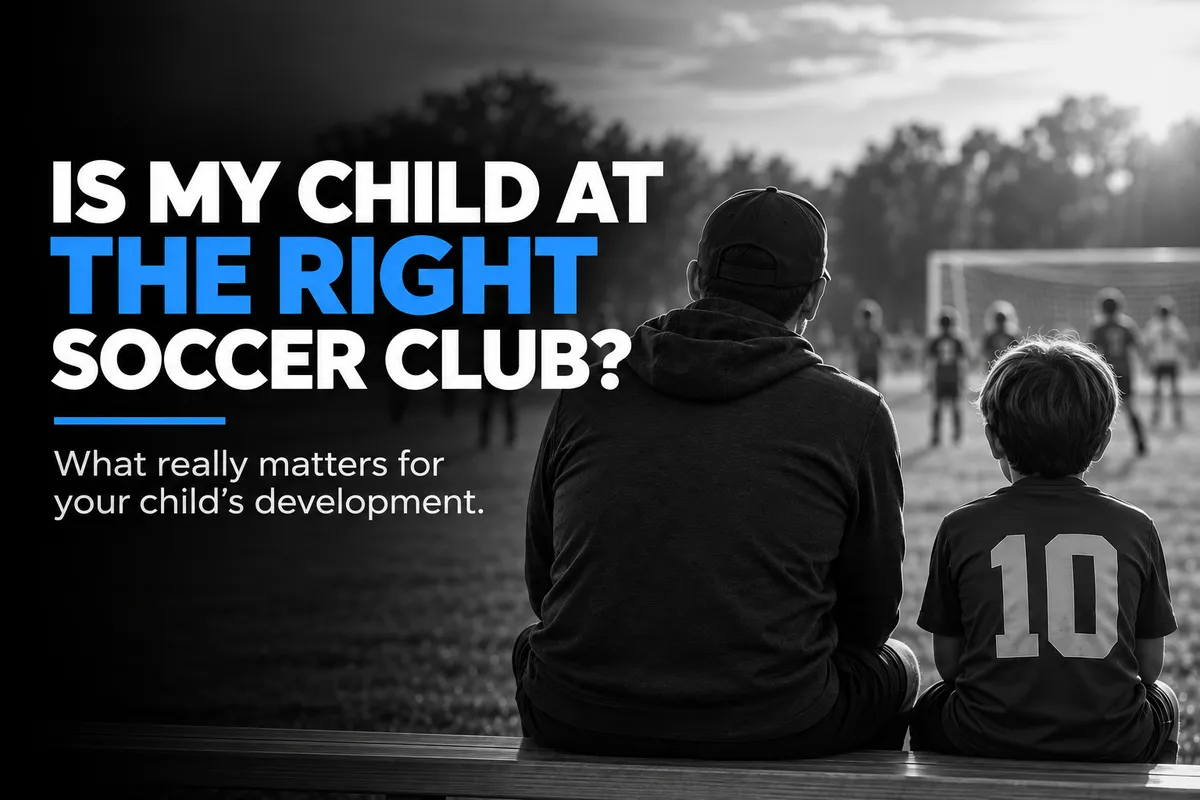
Is My Child at the Right Soccer Club?
How Do I Know If My Child Is at the Right Soccer Club?
It's one of the biggest questions parents face in youth soccer:
Is my child at the right club?
Parents ask this question all the time, but I think we often start in the wrong place.
We look at the club.
How many teams do they have?
What league do they play in?
How much do they win?
How big is the club?
What's their reputation?
Where are the best players in the area playing?
Those things might tell you something about the club.
But they don't necessarily tell you whether it's the right club for your child.
And that's the distinction I want parents to understand.
There is no single “best” soccer club for every child. There is only the right environment for your child at this stage of their development.
So before evaluating the club, I think we need to evaluate something else first.
Your child.
Start With a Different Question
Instead of beginning with:
“Is this a good soccer club?”
Start with:
“What does my child need from a soccer club right now?”
That's a much harder question.
It's also a much more useful one.
Because two children of the exact same age might need completely different things.
One child may need confidence.
Another may need greater competition.
One may need more playing time.
Another may need to be challenged by stronger players.
One may simply need an environment that makes them fall in love with the game.
Another may already be showing unusual motivation and ability and needs a club capable of providing greater developmental challenges.
The club can be exactly the same.
The answer for the two children can be completely different.
That's why I don't think parents should be searching for the universally “best” club.
They should be searching for the environment that fits their child.
For Ages 5–9, Start With Happiness
For younger players, especially around ages 5–9, I think parents sometimes make this much more complicated than it needs to be.
My number one question is:
Is your child happy?
Do they want to go to practice?
Do they get excited when it's time to play?
Do they enjoy being around their teammates?
Do they come off the field wanting to come back?
At this age, I care much more about the child's experience than the parent's opinion of the club.
Maybe you don't love another parent.
Maybe you wish the coach communicated differently.
Maybe another club in town has a better reputation.
Maybe another team wins more games.
Those things can become distractions.
If your eight-year-old is running to the field excited to play soccer, that's important information.
Happiness isn't a soft developmental metric at this age. It's one of the most important ones.
A child who loves going to soccer is going to keep playing.
A child who keeps playing keeps getting opportunities to learn.
And that brings me to the second thing I would evaluate.
Is Your Child Actually Playing?
For young players, playing time matters.
A lot.
Kids at these ages need to play.
They need touches on the ball.
They need decisions.
They need opportunities to try things.
They need to experiment.
And they need to fail.
That's okay. Failure is part of development.
If your child spends the majority of games sitting on the bench, I'd want to understand why.
If they spend large portions of practice standing in long lines waiting for their turn, I'd pay attention to that too.
Young players don't develop by watching other children play soccer.
They develop by playing soccer.
That doesn't mean every minute has to be perfectly productive or every practice needs to look like a professional academy.
They're kids.
But over time, I want to see my child getting meaningful opportunities to participate.
So for the younger ages, my first two questions are pretty simple:
Is my child happy?
Is my child playing?
If both answers are yes, don't underestimate how valuable that can be.
Does the Coach Create an Environment Where Kids Want to Come Back?
The coach matters, but maybe not for the reasons parents sometimes think.
At younger ages, I'm not looking for the coach with the most complicated tactical system.
I'm looking at the environment they create.
Do the kids feel comfortable trying things?
Are mistakes treated as part of learning?
Are players involved?
Is practice active?
Do the kids seem afraid to make mistakes, or are they willing to experiment?
And perhaps most importantly:
Do the kids want to come back?
A coach can know a tremendous amount about soccer and still create the wrong environment for young children.
At these ages, I want a coach who helps create a relationship between the child and the game.
Because if we destroy that relationship chasing short-term results, what exactly have we accomplished?
Don't Confuse Winning With Development
This is one of the biggest traps in youth soccer.
Parents value winning too much.
The team wins almost every weekend, so naturally we assume:
“This must be a great environment.”
Maybe it is.
But winning doesn't answer that question.
What if the team wins every weekend, but your child barely plays?
What if the coach relies heavily on a few physically advanced players while everyone else gets limited opportunities?
What if players are afraid to make mistakes because every mistake could affect the result?
What if training doesn't challenge your child?
The scoreboard tells you who won the game.
It doesn't tell you whether your child developed.
Winning can absolutely be part of a good environment.
I just don't want parents using it as proof that they're in one.
The Biggest Club Isn't Automatically the Best Club for Your Child
Another mistake I see parents make is assuming the largest or most recognizable club in the area must automatically provide the best development.
I understand why.
Big club.
Lots of teams.
Strong reputation.
Recognizable name.
It feels like that's where your child is supposed to be.
But again, we're asking the wrong question.
Don't evaluate the club only by what the club has.
Evaluate it by what your child is actually experiencing.
A smaller club where your child is happy, plays meaningful minutes, gets plenty of touches, has a coach who believes in development, and receives the appropriate level of challenge could be a fantastic situation.
Meanwhile, your child could be at the biggest club in the area and simply be another name on a roster.
The size of the club doesn't develop your child. Their experience inside the club does.
As Players Get Older, the Evaluation Starts to Change
This is where the question becomes more complicated.
The things we've already discussed don't suddenly stop mattering.
Happiness still matters.
Playing still matters.
Coaching still matters.
The environment still matters.
But as players move into roughly the 10–12 age range, especially if they're highly motivated and showing strong development, I think parents need to start asking another question:
Is there enough challenge here for my child?
This is why we can't create one universal checklist for every player.
Imagine two 11-year-olds.
One is an average player who loves soccer, has a good coach, plays regularly, enjoys teammates, and is being appropriately challenged.
That may be a fantastic environment for that child.
Why would we disrupt it simply because another club has a bigger name?
Now imagine another 11-year-old.
This player is highly motivated.
They're progressing quickly.
They're consistently one of the strongest players in their environment.
They're beginning to need something more.
Now the evaluation changes.
We need to know whether the club can continue challenging that child.
Good for one player may not be good for another.
Is There Somewhere for Your Child to Go?
This is one of the most important questions I would ask when evaluating a club for an advancing 10–12-year-old.
If my child outgrows their current environment, what happens next?
For example, if a boy is excelling within his age group, can he get opportunities to train with an older group?
If a girl is excelling, are there appropriate opportunities to train with older players or potentially train with boys?
Can players move into more challenging training environments when they've earned it?
Does the club recognize when a player needs something different?
Or is every child essentially locked into their assigned group regardless of how quickly they develop?
You don't need your child constantly playing up.
More difficult isn't automatically better.
But I want to know that the possibility exists when it's developmentally appropriate.
Because a good developmental environment shouldn't only have a place for your child today.
It should have somewhere for your child to go tomorrow.
Don't Chase Challenge Just Because You Can
There's another side to this.
Once parents realize their child might be ahead, it becomes very easy to chase the hardest environment possible.
Older team.
Better team.
Bigger club.
Stronger players.
More prestigious league.
But challenge only helps when it's appropriate.
If your child moves into an environment where they're constantly overwhelmed, barely touch the ball, stop experimenting, lose confidence, or no longer enjoy playing, we need to ask whether we've actually improved their developmental situation.
The goal isn't to find the hardest environment.
The goal is to find the right amount of challenge.
Enough difficulty that the player has to adapt.
Enough opportunity that they can actually do it.
That's a balance parents need to watch carefully.
Watch Your Child's Experience, Not the Club's Marketing
If you're evaluating your current club, I would spend less time worrying about what the club says it provides and more time watching what your child actually experiences.
Go to practice and watch differently.
Don't just watch your child.
Watch the environment.
Are kids moving or standing?
Are they making decisions?
Are they getting touches?
Are they allowed to try things?
What happens when someone makes a mistake?
Does the coach teach?
Does the coach encourage?
Does your child receive appropriate challenges?
Are stronger players given opportunities to stretch themselves?
And then watch your child after training.
Do they seem energized?
Do they talk about what happened?
Do they want to come back?
Those observations can tell you far more than a club brochure ever will.
A Simple Club Check-In for Parents
If you're wondering whether your child is at the right soccer club, periodically step back and ask:
1. Is my child happy and excited to play?
2. Is my child getting meaningful opportunities to actually play soccer?
3. Does the coaching environment allow players to experiment, make mistakes, and learn?
4. Is my child being challenged appropriately for where they are right now?
5. Is my child becoming more confident and independent?
6. If my child develops faster than expected, does this club have opportunities to challenge them further?
7. Am I evaluating the club based on my child's experience—or am I being influenced by winning, reputation, size, or what other parents think?
Don't turn these questions into another scorecard.
Use them to think.
One negative answer doesn't automatically mean you should leave.
It means you may have found something worth understanding better.
Understand Before You Make a Move
If you're unhappy with your child's club, resist the urge to immediately start looking for another one.
First figure out what's actually wrong.
Is your child unhappy?
Are they not playing enough?
Is the training environment poor?
Are they no longer being challenged?
Is there no pathway for them if they continue progressing?
Or did the team simply lose three games and now you're frustrated?
Those are very different problems.
And they'll require very different decisions.
This is why I don't believe there is a simple answer to:
“Is my child at the right soccer club?”
The answer depends on the child.
Their age.
Their happiness.
Their playing opportunities.
Their current ability.
Their motivation.
And what they need next.
Stop Looking for the Best Club
Parents naturally want the best for their children.
So we search for the best coach.
The best team.
The best league.
The best club.
But youth soccer doesn't work that neatly.
The biggest club may not be the best environment for your child.
The team that wins the most may not be the best developmental situation.
And the environment that's perfect for another child may be completely wrong for yours.
So I'd replace:
“Is my child at the best soccer club?”
with:
“Is this club giving my child what they need at this stage of their development?”
If your child is happy, playing, learning, being appropriately challenged, and has somewhere to go as they develop, you may already have something very valuable.
Don't overlook it because somebody else's child is wearing a different badge.
Parent Anchor
The best club isn't the biggest club or the team that wins the most—it's the environment that gives your child what they need at this stage of their development.
Want to Make Better Decisions About Your Child's Soccer Journey?
The Soccer Blueprint helps parents understand how to evaluate their child's development, environment, coaching, playing opportunities, and pathway without making decisions based solely on wins, club reputation, or what everyone else is doing.
The goal isn't to tell you which club to choose.
It's to help you understand how to decide what's right for your child.
Explore The Soccer Blueprint
